 Skarp
Skarp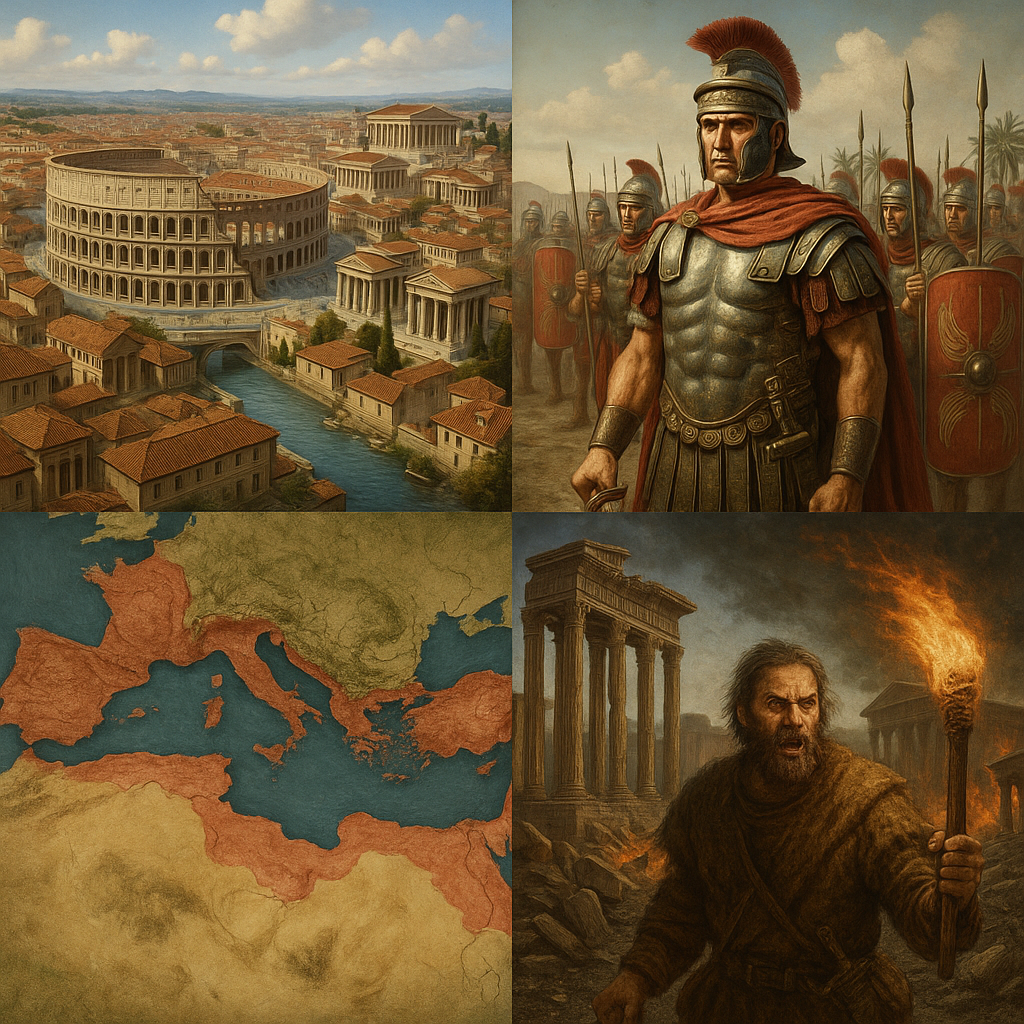
Ancient Rome: Rise and Fall of an Empire
Explore how a small city-state on the Tiber River expanded into a vast empire and eventually collapsed. This course traces the political, military, social, and cultural forces behind Rome’s rise to power and its ultimate fall.
The first lecture plays free — no account needed.
What you'll learn
- Students will be able to locate Rome and explain why its geography supported expansion.
- Students will understand the difference between Rome’s legendary origins and historical evidence.
- Students will be able to describe how early neighbors influenced Roman culture and politics.
- Students will be able to summarize how and why Rome shifted from kings to a republic.
- Students will be able to identify the main political institutions of the Roman Republic and their roles.
- Students will understand the social conflict between patricians and plebeians and key reforms.
- Students will be able to explain the significance of the Twelve Tables as a foundation of Roman law.
- Students will be able to connect Roman republican ideas to later democratic traditions.
- Students will be able to describe how the Roman army was structured and why it was effective.
- Students will understand the causes, key events, and outcomes of the Punic Wars.
Prerequisites
- Geographical and early historical context of Rome
- Basic understanding of monarchy vs. republic
- Knowledge of Roman Republican institutions and social groups
- Understanding of Roman expansion and its economic and social effects
- Knowledge of late Republican civil wars and the fall of the Republic
- Basic understanding of the structure and extent of the Roman Empire under Augustus and his successors
Course Content
9 modules · 2h 15m total
From Village to Power: Origins of Rome
Introduce the geographical, cultural, and legendary origins of Rome and how its early setting shaped its future expansion.
The Roman Republic: Institutions and Ideals
Examine how the Roman Republic was governed and how its political system balanced power among different groups.
Conquering the Mediterranean: Expansion and the Punic Wars
Explore how Rome expanded from a regional power to a Mediterranean empire, focusing on the Punic Wars and their consequences.
Crisis in the Republic: Inequality, Reform, and Civil War
Analyze the internal tensions that destabilized the late Republic, including economic inequality, political violence, and ambitious leaders.
Augustus and the Birth of the Empire
Study how Augustus transformed Rome from a republic into an empire while maintaining the appearance of traditional institutions.
Life in the Roman Empire: Society, Culture, and Religion
Look beyond politics to examine everyday life, social hierarchy, and cultural and religious practices across the empire.
Power and Problems: Emperors, Frontiers, and Administration
Investigate how the empire was managed at its height and the challenges it faced from within and at its borders.
Decline and Fall: From Division to the End of the Western Empire
Trace the long process of Rome’s decline in the West, considering political fragmentation, invasions, and internal weaknesses.
Rome’s Legacy: Law, Language, and the Idea of Empire
Conclude by examining how Roman institutions, culture, and imagery continued to shape Europe and the wider world long after the fall of the Western Empire.
Read the Textbook
Read every chapter for free, right here in your browser.
Rome did not start as a mighty empire. It began as a small village on the Italian peninsula and gradually turned into a Mediterranean superpower.
Locate Rome: Continent: Europe Country today: Italy Region: Central-western Italy Specific spot: On the Tiber River, about 25 km (15 miles) from the Tyrrhenian Sea, on a group of hills (traditionally Seven Hills).
Key geographic advantages: River access: The Tiber allowed trade and communication inland, but Rome was far enough from the sea to be slightly safer from pirates and sudden sea attacks. Hills: The hills gave natural high ground for defense. Central position in Italy: From central Italy, Rome could expand north (toward the Etruscans), south (toward Greek colonies and other Italic peoples), and later across the Mediterranean. Fertile plains: The surrounding region, Latium, had good farmland to support a growing population and army.
Study Flashcards
Key concepts from this course as flashcard pairs.
From Village to Power: Origins of Rome
Latium
The region of central western Italy where Rome is located; home of Latin-speaking communities including early Rome.
Tiber River
The river on which Rome was founded, providing water, trade routes, and partial protection from sea attacks.
Romulus and Remus
Legendary twin brothers raised by a she-wolf; Romulus is said to have founded Rome after killing Remus.
Aeneas
A Trojan hero in Roman legend who fled Troy and settled in Italy; considered an ancestor of the Roman people in myth.
Etruscans
A powerful ancient people north of Rome whose culture influenced Roman religion, architecture, and symbols of power.
Magna Graecia
Latin term meaning 'Great Greece'; refers to the Greek colonies in southern Italy and Sicily that influenced Roman culture.
+4 more flashcards
The Roman Republic: Institutions and Ideals
Roman Republic
System of government in Rome (from 509 BCE until the 1st century BCE) where power was shared among elected magistrates, the Senate, and citizen assemblies instead of being held by a king.
Consuls
The two highest magistrates in the Roman Republic, elected for one year to lead the government and the army; each could veto the other.
Senate
A council of elite Roman men (mostly former magistrates) that advised magistrates, controlled finances, and directed foreign policy; the most powerful long-term institution of the Republic.
Assemblies
Gatherings of Roman citizens organized by wealth, tribe, or social group to vote on laws and elect magistrates (e.g., Centuriate Assembly, Tribal Assembly, Plebeian Council).
Patricians
Members of Rome’s old, noble families who originally held many religious and political privileges.
Plebeians
All other Roman citizens who were not patricians; they ranged from poor farmers to wealthy merchants and fought for more political rights.
+5 more flashcards
Conquering the Mediterranean: Expansion and the Punic Wars
Legion
The main unit of the Roman army, usually 4,000–5,000 citizen infantry plus cavalry, organized into smaller sub-units (maniples in the mid-Republic).
Maniple
A flexible sub-unit of a Roman legion (about 120 men) used in the mid-Republic, arranged in a checkerboard pattern to allow maneuvering.
Punic Wars
Three major wars between Rome and Carthage (264–146 BCE) that led to Roman control of the western Mediterranean.
Hannibal
Carthaginian general who led his army (and war elephants) over the Alps into Italy during the Second Punic War and won major battles like Cannae.
Cannae
A battle in 216 BCE where Hannibal used a double envelopment to surround and destroy a large Roman army; one of Rome’s worst defeats.
Province
A territory outside Italy under Roman control, governed by a Roman official who collected taxes and commanded troops.
+4 more flashcards
Crisis in the Republic: Inequality, Reform, and Civil War
Latifundia
Large agricultural estates in the Roman Republic, often built from absorbed small farms and public land (ager publicus), worked mainly by slaves and owned by wealthy elites. They increased economic inequality.
Urban poverty (late Republic)
The condition of many landless Roman citizens who crowded into Rome and other cities after losing farms. They relied on casual work, grain distributions, and political patrons.
The Gracchi brothers
Tiberius and Gaius Gracchus, tribunes in the 2nd century BCE who attempted land and social reforms to help poor citizens. Their violent deaths marked the rise of political murder in Roman politics.
Marius’ military reforms
Changes by Gaius Marius around 107 BCE that allowed landless poor citizens to serve in the army, with the state providing equipment. This encouraged personal loyalty to generals who promised pay and land.
Sulla’s march on Rome
In 88 BCE, Sulla led his legions into Rome to seize power, breaking tradition and showing that a general with loyal troops could overrule republican institutions.
Proscriptions
Lists of enemies of the state published by Sulla (and later others). People on the lists could be killed without trial and their property confiscated, turning violence into a political tool.
+2 more flashcards
Augustus and the Birth of the Empire
Octavian / Augustus
Julius Caesar’s adopted heir who, after winning the civil wars, became the first Roman emperor. He took the title Augustus in 27 BCE and created the Principate.
Principate
The system of government established by Augustus, where the emperor (princeps) held dominant power while republican institutions like the Senate and magistracies continued to exist in form.
Imperium maius
“Greater command” power held by Augustus, giving him superior authority over other governors, especially in provinces with legions.
Tribunicia potestas
Tribunician power held by Augustus, allowing him to propose laws and veto measures, similar to the powers of the people’s tribunes but held continuously.
Pax Romana
The “Roman Peace,” a long period of relative stability and order beginning under Augustus, which supported economic growth and imperial unity.
Ara Pacis Augustae
The Altar of Augustan Peace in Rome, a monument celebrating peace, prosperity, and Augustus’s role as restorer of order and piety.
+3 more flashcards
Life in the Roman Empire: Society, Culture, and Religion
Senatorial order (ordo senatorius)
The highest social and political class in Roman society, made up of wealthy families eligible for seats in the Senate and top offices.
Equestrian order (ordo equester)
A wealthy social class below senators, often involved in business, tax collection, and imperial administration.
Freedperson (libertus / liberta)
A former enslaved person who has been legally freed; became a Roman citizen but with some limits on political rights.
Insula
A multi-story Roman apartment building, often crowded and unsafe, where many urban poor and middle-class people lived.
Thermae
Large public bath complexes in Roman cities that served as social, recreational, and sometimes cultural centers.
Pax deorum
Literally “peace of the gods”; the Roman idea that correct rituals kept a good relationship between gods and community.
+4 more flashcards
Power and Problems: Emperors, Frontiers, and Administration
Province
A large territorial unit of the Roman Empire governed by an official (such as a governor) who handled law, taxes, and security for that region.
Legion
The main heavy infantry unit of the Roman army, usually about 5,000–6,000 soldiers, stationed mostly along the empire’s frontiers.
Frontier (Limes)
The border zone of the Roman Empire, often marked by rivers, walls, forts, and roads, where troops were stationed to control movement and defend against raids.
Tetrarchy
The system introduced by Diocletian in the late 3rd century CE in which four emperors (two Augusti and two Caesares) shared rule over different parts of the empire.
Debasement
Reducing the precious metal content (like silver) in coins while keeping their face value, often leading to inflation as people lose trust in the currency.
Edict of Milan
A proclamation issued in 313 CE under Constantine and Licinius that granted religious toleration in the Roman Empire, especially protecting Christians.
+1 more flashcards
Decline and Fall: From Division to the End of the Western Empire
Third-Century Crisis
A period roughly from 235–284 CE when the Roman Empire faced severe political chaos (many short-lived emperors), invasions, economic problems, and temporary breakaway regions, nearly causing the empire to collapse.
Tetrarchy
Diocletian’s system of rule by four emperors (two Augusti and two Caesares), designed to share power and make governing the vast empire more stable and efficient.
Constantinople
A major eastern city founded as a capital by Constantine (modern Istanbul). It became the center of the Eastern Roman (Byzantine) Empire and helped that half survive long after the West fell.
Foederati (Federates)
Non-Roman allied groups, often Germanic, settled on Roman land in exchange for military service, keeping some autonomy under their own leaders.
Visigoths
A Gothic group who entered the empire, fought the Romans, defeated them at Adrianople (378), and later sacked Rome in 410 before founding a kingdom in Gaul and Spain.
Vandals
A Germanic group that moved through Gaul and Spain into North Africa, took Carthage, and sacked Rome in 455, weakening the Western Empire’s economy.
+3 more flashcards
Rome’s Legacy: Law, Language, and the Idea of Empire
Roman law
A complex legal tradition developed in ancient Rome, especially summarized in Justinian’s Corpus Juris Civilis, that strongly influenced later civil law systems in Europe and beyond.
Civil law system
A legal system based on written codes and statutes (often inspired by Roman law), rather than primarily on judges’ past decisions.
Corpus Juris Civilis
The 'Body of Civil Law' compiled under Emperor Justinian in the 6th century CE; a key source for later European legal traditions.
Romance languages
Languages that developed from Latin, including Italian, French, Spanish, Portuguese, and Romanian.
Republic (res publica)
Originally in Rome, a system where power is held by citizens and their representatives rather than by a king; today, a state that claims authority from the people.
Imperium
In Roman law, the legal authority to command armies and govern; the root of the modern word 'empire.'
+2 more flashcards
More in History
See all →
The Origin Story of the English Alphabet
Yhdysvaltain sisällissota: syyt, kulku ja seuraukset
Första världskriget för åk 8: Från skottet i Sarajevo till Versaillesfreden
Decisive Battles of the American Civil War

World War I: A Global War and Its Lasting Aftermath
