 Skarp
Skarp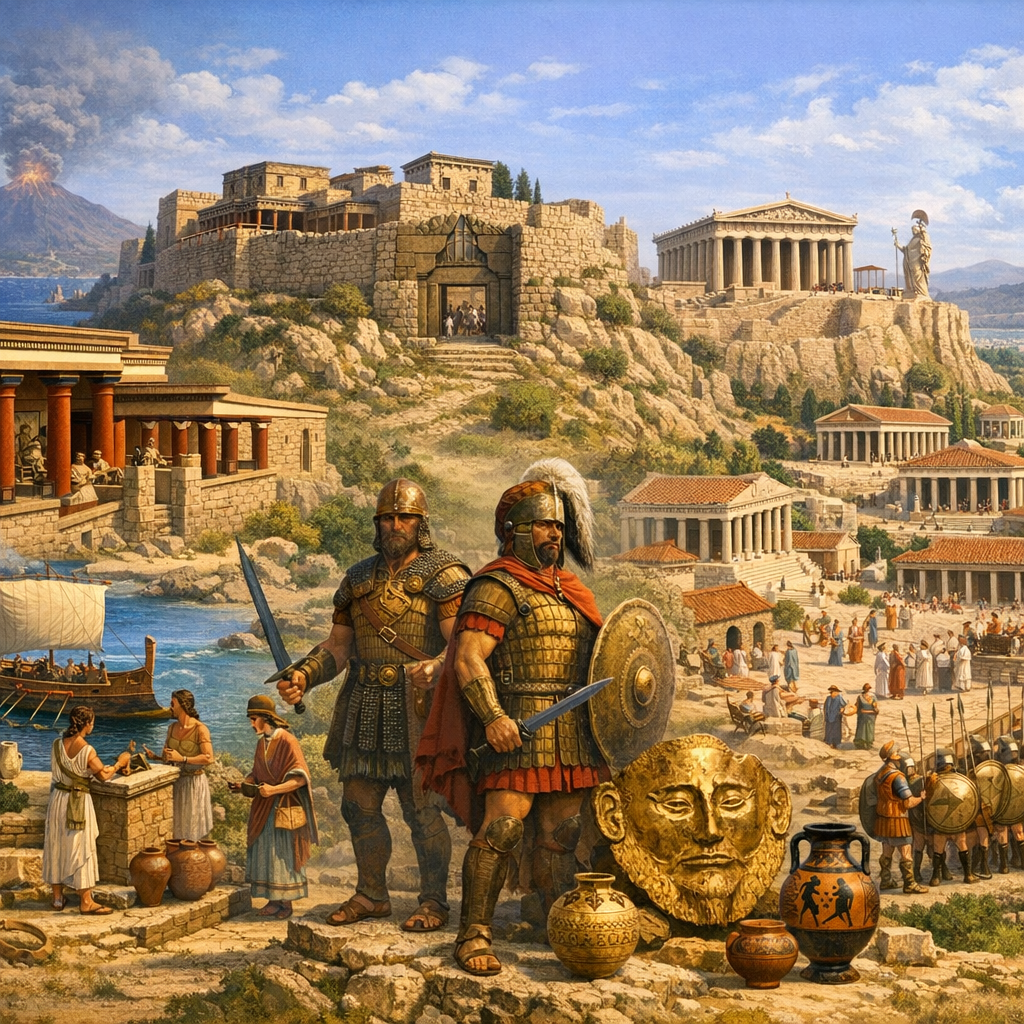
Ancient Greece: From Bronze Age Kingdoms to the Classical Polis
Trace the roots of Ancient Greece from the palaces of the Minoans and Mycenaeans through the Greek Dark Age and Archaic period to the rise of the classical city‑state. This course builds a clear timeline, maps key regions, and unpacks political and cultural foundations that prepare you for deeper study of democracy, the Persian Wars, and Greek philosophy.
The first lecture plays free — no account needed.
What you'll learn
- Students will be able to place the Bronze Age, Greek Dark Age, Archaic period, and Classical period in correct chronological order with approximate dates.
- Students will understand how the geography of the Aegean region shaped early Greek societies and their interactions.
- Students will be able to distinguish between archaeological and literary evidence and explain why our knowledge of early Greece is incomplete and debated.
- Students will be able to summarize who the Minoans were, where they lived, and when their civilization flourished in the Aegean Bronze Age.
- Students will understand the role of palaces, trade, and seafaring in sustaining Minoan society.
- Students will be able to identify key Minoan cultural features (art styles, religious symbols, writing systems) that influenced or contrasted with later Greek traditions.
- Students will be able to describe the main features of Mycenaean civilization, including its palatial structure and geographic spread.
- Students will understand the significance of Linear B tablets for reconstructing Mycenaean society and the early history of the Greek language.
- Students will be able to compare Minoan and Mycenaean societies in terms of economy, political organization, and cultural expression.
- Students will be able to outline the main features of the Late Bronze Age collapse and its impact on Mycenaean Greece.
Prerequisites
- Major periods of Greek history
- Basic geography of the Greek world
- Timeline of Bronze Age and later periods
- Basic understanding of Minoan civilization
- Knowledge of Mycenaean palatial society and its regional context
- Overview of the Greek Dark Age and its origins in the Late Bronze Age collapse
Course Content
11 modules · 1h 54m total
Setting the Stage: Time, Space, and Sources for Early Greek History
Ancient Greece did not begin with marble temples and philosophers in togas. Step back into a world of scattered islands, shifting seas, and fragmentary evidence to see how historians reconstruct the long journey from Bronze Age kingdoms to classical city‑states.
Palaces and Sea Kings: The Minoans of Bronze Age Crete
Before mainland Greece produced warrior kings, an island civilization built sprawling palaces and vivid frescoes in the heart of the Aegean. Enter the world of the Minoans, whose ships, myths, and art helped lay foundations for later Greek culture.
Warlike Kingdoms: Mycenaean Greece and the Late Bronze Age
Behind the legends of Agamemnon and the Trojan War stood real fortified palaces, warrior elites, and a bureaucratic world recorded in an early form of Greek. Meet the Mycenaeans, the mainland counterparts and successors to the Minoans.
Collapse and Obscurity: The Late Bronze Age Crisis and Greek Dark Age
Around 1200 BCE, palaces burned, trade routes faltered, and complex kingdoms across the eastern Mediterranean unraveled. Follow the shockwaves of the Late Bronze Age collapse into the centuries often called Greece’s ‘Dark Age’.
From Chiefs to Communities: Society and Power in Dark Age Greece
Out of the ruins of the palaces emerged small, kin-based communities led by local chiefs rather than great kings. Discover how social ties, gift‑giving, and heroic ideals kept order in a world without bureaucrats or stone fortresses.
Rebirth and Innovation: The Archaic Age and the Return of Writing
After centuries of relative obscurity, Greek communities reconnected with wider Mediterranean networks, adopted a new alphabet, and began to leave their mark in stone and verse. Watch the Archaic period transform Greece from scattered villages into a vibrant, outward‑looking world.
Inventing the City-State: The Rise and Structure of the Polis
The most distinctive Greek political invention was not an emperor or a parliament, but the polis: a community of citizens tied to a city and its lands. Step inside this new kind of political world to see how it worked—and why it proved so influential.
Many Paths to Power: Monarchies, Oligarchies, Tyrannies, and Early Democracies
Not all Greek city‑states were democracies—and democracy itself evolved out of fierce struggles between kings, aristocrats, would‑be tyrants, and ordinary citizens. Trace the competing political experiments that unfolded within the framework of the polis.
Beyond the Homeland: Colonization, Trade, and the Wider Greek World
From Spain to the Black Sea, Greek settlers and merchants carried their language, gods, and institutions far beyond the Aegean. Follow their ships to see how new poleis abroad reshaped economies, identities, and power back home.
Lives Within the Polis: Social Hierarchies, Gender, and Religion
Behind the public assemblies and battle lines stood households, rituals, and everyday routines that shaped what it meant to be a free citizen, a woman, a foreigner, or a slave. Step into the social and religious fabric that held the polis together.
Foundations of the Classical Age: From Archaic Experiments to Persian Wars and Philosophy
By the early fifth century BCE, Greek city‑states had forged distinctive political systems, far‑flung networks, and shared cultural ideals—just as a new superpower loomed in the east. See how developments from the Bronze Age onward converged to launch the Classical era of wars, drama, and philosophy.
Read the Textbook
Read every chapter for free, right here in your browser.
Ancient Greece did not begin with marble temples and famous philosophers. For many centuries, the Greek world was a patchwork of small communities scattered across mountains, islands, and coasts.
Historians today reconstruct this early history using fragmentary evidence. We combine archaeology (ruins, pottery, graves), early texts (like Homer), later written histories (like Herodotus and Thucydides), and art (vase paintings, sculptures). Each type of evidence has strengths and limits.
Key challenge: before about 800 BCE, written records from Greece itself are scarce. The Bronze Age has some palace records in Linear B, but they are short, practical notes, not stories. The centuries after the Bronze Age collapse (the so‑called Dark Age) leave almost no writing at all. As a result, our picture of early Greece is incomplete and often debated.
Study Flashcards
Key concepts from this course as flashcard pairs.
Setting the Stage: Time, Space, and Sources for Early Greek History
Bronze Age Greece (basic dates and feature)
c. 3000–1050 BCE. Characterized by palatial centers (e.g. Mycenae, Knossos), use of bronze, long-distance trade, and Linear B administrative records in the Late Bronze Age.
Greek Dark Age / Early Iron Age (basic dates and feature)
c. 1050–800 BCE. Loss of palaces and Linear B writing, population decline, simpler material culture; called "Dark" because of scarce written sources.
Archaic Period (basic dates and feature)
c. 800–480 BCE. Rise of the polis (city-state), adoption of the Greek alphabet, colonization, early temples, and the recording of epic and lyric poetry.
Classical Period (basic dates and feature)
c. 480–323 BCE. Begins after the Persian Wars; height of Athenian democracy, drama, philosophy, and monumental architecture; ends with Alexander the Great’s death.
Polis
A Greek city-state: a community with its own political institutions, territory, and identity (e.g. Athens, Sparta, Corinth). Central in Archaic and Classical Greece.
Archaeological evidence
Physical remains such as buildings, pottery, tools, graves, and ecofacts. Crucial for periods with few texts, especially the Bronze Age and Dark Age.
+4 more flashcards
Palaces and Sea Kings: The Minoans of Bronze Age Crete
Minoans
A Bronze Age civilization centered on Crete and nearby islands, flourishing roughly 2000–1450 BCE, known for palaces, seafaring, and distinctive art.
Knossos
The largest Minoan palace center on Crete, excavated by Arthur Evans, featuring a central courtyard, magazines, workshops, and famous frescoes.
Redistribution (Palace Economy)
An economic system in which goods are collected by a central authority (the palace), recorded, stored, and then redistributed to workers, elites, and for trade.
Linear A
A Minoan script used mainly for administrative and religious records; it writes the Minoan language and remains undeciphered as of 2026.
Linear B
A script adapted from Linear A by Mycenaean Greeks to write early Greek; used at Knossos and mainland palaces and deciphered in 1952.
Thalassocracy
A term meaning "sea-power" or maritime dominance; later Greeks described Minos this way, reflecting Minoan strength in seafaring and trade.
+2 more flashcards
Warlike Kingdoms: Mycenaean Greece and the Late Bronze Age
Mycenaean
Name for Greek-speaking peoples who dominated the Aegean in the Late Bronze Age (c. 1600–1100 BCE), centered on fortified palaces like Mycenae, Tiryns, Pylos, and Thebes.
Palace center
A fortified complex that served as royal residence, administrative hub, storage and workshop area, and religious center in Mycenaean (and earlier Minoan) society.
Megaron
The main hall of a Mycenaean palace: a rectangular room with a central hearth and four columns, used for royal audiences and feasting.
Wanax
The top ruler or king in Mycenaean society, known from Linear B tablets; controlled land, warfare, and major religious activities.
Lawagetas
High-ranking Mycenaean official, probably a leading noble or military commander, second only to the wanax.
Linear B
Syllabic script used mainly for Mycenaean palace administration in the 13th–12th centuries BCE; records an early form of Greek and consists mostly of economic records.
+4 more flashcards
Collapse and Obscurity: The Late Bronze Age Crisis and Greek Dark Age
Late Bronze Age collapse
A period c. 1250–1100 BCE when many complex societies around the eastern Mediterranean (including Mycenaean Greece) experienced palace destructions, population shifts, and breakdowns in trade and writing.
Mycenaean palatial system
The Late Bronze Age political and economic structure in mainland Greece centered on fortified palaces that controlled land, labor, and trade using a redistributive economy and Linear B records.
Linear B
A syllabic script used to write an early form of Greek in Mycenaean palaces. It disappears after the palace destructions and is not used in the Greek Dark Age.
Greek Dark Age / Early Iron Age
The period roughly 1200–800 BCE in Greece, marked by the end of palatial centers, loss of writing, smaller settlements, simpler material culture, and the gradual spread of iron technology.
Sub-Mycenaean, Protogeometric, Geometric
Successive pottery styles after the fall of the palaces: Sub-Mycenaean (simplified Mycenaean), Protogeometric (precise geometric designs), and Geometric (more complex patterns and later figures).
Redistributive economy
An economic system where a central authority (like a palace) collects goods (taxes, produce) and then redistributes them to the population, common in Mycenaean and other Bronze Age palatial societies.
+1 more flashcards
From Chiefs to Communities: Society and Power in Dark Age Greece
Greek Dark Age
Period roughly 1100–800 BCE after the collapse of Mycenaean palaces, marked by smaller settlements, loss of writing, and simpler political structures, but also by the development of new forms of community and leadership.
Oikos
The household in Dark Age and later Greece: a basic social and economic unit including family members, dependents, land, animals, and stored goods.
Big man / local chief
A leader whose power is based on personal qualities and relationships—success in war, gift-giving, and persuasion—rather than on a formal office or bureaucracy.
Genos (plural: genē)
An extended kin group or clan. In the Dark Age, such kin groups were key for support, alliances, and leadership.
Timē (honor)
A person's recognized worth in the community, based on bravery, generosity, and loyalty. Central to social order in Dark Age and Homeric society.
Oral tradition
The passing down of stories, poems, and knowledge by word of mouth. In Dark Age Greece, it preserved memories of the Mycenaean past and shaped epics like the Iliad and Odyssey.
+3 more flashcards
Rebirth and Innovation: The Archaic Age and the Return of Writing
Archaic Period (c. 800–480 BCE)
A phase of Greek history marked by the rise of city-states, adoption of the alphabet, expansion of trade and colonization, development of written laws, and growth of Panhellenic sanctuaries and games.
Greek Alphabet
A writing system adapted from the Phoenician script in the late 9th–early 8th century BCE, notable for including letters for vowel sounds, making it easier to learn and use for poetry, law, and everyday inscriptions.
Polis (plural: poleis)
A Greek city-state consisting of an urban center and its surrounding territory, along with its community of citizens and political institutions such as assemblies, councils, and magistrates.
Panhellenism
The sense of shared identity among Greeks across different city-states, strengthened by common language, myths, sanctuaries, and festivals such as the Olympic Games.
Hoplite
A heavily armed Greek infantry soldier who fought in a close-ordered formation called a phalanx; often a citizen with enough property to afford armor and weapons.
Tyrant (Archaic sense)
A single ruler who seized power outside traditional aristocratic or legal channels in a Greek city-state; often sponsored public works and festivals, not necessarily cruel in the modern sense.
+4 more flashcards
Inventing the City-State: The Rise and Structure of the Polis
Polis
A Greek city‑state: a community of citizens with an urban center, surrounding territory, shared institutions, and a common identity.
Asty
The urban center of a polis: the main town or city where markets, public buildings, and many political and religious activities are located.
Chora
The countryside territory of a polis, including farms, villages, and pastureland that support the city economically.
Politai
The citizens of a polis, usually free adult males with political rights and duties such as military service and assembly participation.
Politeia
The overall political arrangement or constitution of a polis, including its institutions, offices, and rules of decision‑making.
Agora
The central open space in a Greek city used as a marketplace and main public gathering area for politics and social life.
+4 more flashcards
Many Paths to Power: Monarchies, Oligarchies, Tyrannies, and Early Democracies
Polis
A Greek city‑state: a community of citizens linked to a city and its surrounding territory, sharing laws, cults, and political institutions.
Monarchy (basileia)
Rule by a single king, often hereditary and tied to religious roles. In the Archaic polis, full monarchies were rare and usually checked by other bodies.
Oligarchy (oligarchia)
Rule by the few: a small group of wealthy families dominate offices and decisions, often limiting political rights by property.
Tyranny (tyrannis)
One man seizes power outside normal rules, often with popular or military support. In Archaic Greece, tyrants could be harsh but also reforming.
Democracy (demokratia)
Literally "power of the people": in Greek poleis, a system where male citizens collectively make key decisions in assemblies and courts.
Hoplite
A heavily armed infantry soldier, usually a citizen farmer, fighting in a phalanx. Their importance in war strengthened demands for political voice.
+4 more flashcards
Beyond the Homeland: Colonization, Trade, and the Wider Greek World
Polis
A Greek city-state: a community of citizens tied to a city and its surrounding territory, with its own institutions and identity.
Metropolis (in Greek colonization)
The "mother city" that founded a colony. It supplied the leader and initial settlers but did not usually rule the colony directly.
Oikist
The founder and leader of a Greek colony, responsible for organizing the expedition and honored as a hero in the new city.
Magna Graecia
Latin for "Great Greece": the region of southern Italy and Sicily with many Greek cities, heavily settled from the 8th century BCE onward.
Emporion / emporia
A trading post or market center, often multi-ethnic, that facilitated exchange without necessarily being a full polis.
Phoenicians
Seafaring traders from the Levant (cities like Tyre and Sidon). They founded colonies such as Carthage and strongly influenced Greek writing and trade.
+3 more flashcards
Lives Within the Polis: Social Hierarchies, Gender, and Religion
Polis
A Greek city‑state understood as a physical city, a political community of citizens, and a network of social and religious relationships.
Oikos
The household unit in Greek society, including family members, slaves, land, buildings, and property; the basic building block of the polis.
Kyrios
The male head of a household who legally represented the oikos, arranged marriages, and controlled major property decisions.
Citizen (in a Greek polis)
A free person, usually an adult male born from citizen parents, with political rights and duties such as voting, holding office, and military service.
Metic
A free, non‑citizen resident of a polis, often an immigrant or descendant of immigrants, who could work and pay taxes but lacked political rights.
Slave
A person legally owned by another, lacking political rights and treated as property, whose labor supported households and the polis economy.
+2 more flashcards
Foundations of the Classical Age: From Archaic Experiments to Persian Wars and Philosophy
Bronze Age (in Greek context)
Period c. 3000–1100 BCE marked by palace-based kingdoms like Minoan Crete and Mycenaean Greece, with centralized rule, palaces, and Linear B records.
Dark Age / Early Iron Age
Period c. 1100–800 BCE after the collapse of palaces, with population decline, loss of writing, and more local, small-scale political structures.
Polis
Greek city-state; both the urban center and its citizen community, sharing laws, cults, and identity, with institutions like assemblies and councils.
Tyranny (Archaic Greece)
One-man rule that often arose by exploiting social tensions; tyrants were not always cruel and sometimes sponsored building projects and the arts.
Achaemenid Persian Empire
Large multi-ethnic empire founded by Cyrus the Great in the 6th century BCE, organized into satrapies under the Great King.
Ionian Revolt
Revolt of Greek cities in Ionia (499–494 BCE) against Persian rule, supported by Athens and Eretria, helping trigger the Persian Wars.
+4 more flashcards
More in History
See all →
The Origin Story of the English Alphabet
Yhdysvaltain sisällissota: syyt, kulku ja seuraukset
Första världskriget för åk 8: Från skottet i Sarajevo till Versaillesfreden
Decisive Battles of the American Civil War

World War I: A Global War and Its Lasting Aftermath
