Skarp
Skarp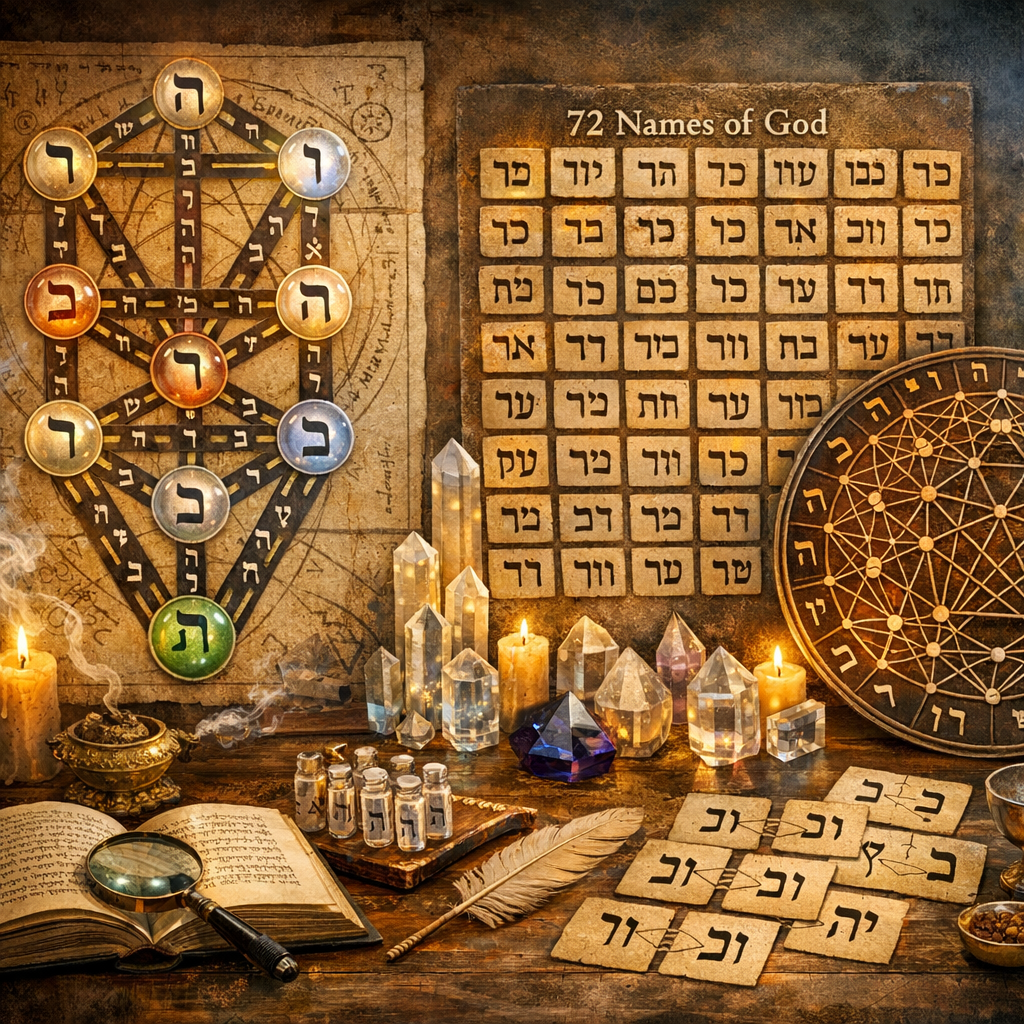
Advanced Kabbalah Lab: Tree of Life, Hebrew Letters, 72 Names & the 231 Gates in Practice
A non-introductory, practice-centered immersion into the core architectures of classical Kabbalah. You will work directly with the sefirot as states of consciousness, the 22 Hebrew letters as creative forces, selected 72 Names as structured meditative technologies, and the 231 Gates of Sefer Yetzirah as contemplative permutations for inner transformation and subtle perception.
The first lecture plays free — no account needed.
What you'll learn
- Students will be able to articulate the difference between conceptual study of Kabbalah and an experiential, practice-based approach.
- Students will understand the core architectures to be used in the course: sefirot, Tree of Life, Hebrew letters, 72 Names, and 231 Gates.
- Students will be able to identify basic ethical and psychological boundaries for safe engagement with intensive inner practices.
- Students will be able to locate the ten sefirot on a basic Tree of Life diagram and describe each as a state of consciousness.
- Students will understand one somatic or breath-based exercise for sensing the flow between at least three sefirot (e.g., Chesed–Gevurah–Tiferet).
- Students will be able to record observations from a short sefirotic body-scan meditation in a structured journal format.
- Students will be able to define the Four Worlds (Atzilut, Beriah, Yetzirah, Assiyah) in terms of lived experience rather than abstract cosmology.
- Students will understand how a single sefirah (e.g., Tiferet) can be experienced differently in each world.
- Students will be able to perform a brief exercise that moves a simple intention through all four worlds (idea, emotion, image, deed).
- Students will be able to describe the idea of Hebrew letters as creative forces rather than mere phonetic signs.
Prerequisites
- Overview of sefirot and Tree of Life from Module 1
- Familiarity with sefirot as states of consciousness (Module 2)
- Orientation to course architectures (Module 1)
- Basic Tree of Life familiarity (Module 2)
- Sefirotic states of consciousness (Module 2)
- Hebrew letters as creative forces (Module 4)
Course Content
14 modules · 3h 15m total
From Map to Laboratory: Orienting to an Experiential Kabbalah Practice
This opening session turns the Tree of Life from a static diagram on the page into a living laboratory of consciousness, framing how sefirot, letters, Names, and Gates can become daily inner practices instead of abstract metaphysics.
Tree of Life as States of Consciousness: Sefirot in the Body and Psyche
Rather than memorizing ten spheres, you will trace how each sefirah shows up in your thinking, feeling, and embodiment, turning the Tree of Life into a felt map of your own nervous system and inner life.
Four Worlds and the Vertical Axis: Situating Practice in Atzilut, Beriah, Yetzirah, Assiyah
This session stretches the Tree of Life into four dimensions, revealing how thought, emotion, imagery, and action mirror the four Kabbalistic worlds and how your practice can deliberately shift among them.
The 22 Hebrew Letters as Creative Forces: Sound, Shape, and Direction
Stepping into Sefer Yetzirah’s vision, you will encounter the Hebrew letters not as a language to be spoken, but as primordial building blocks of perception, each carrying a specific energetic flavor and contemplative doorway.
Thirty-Two Paths of Wisdom: Wiring Sefirot and Letters Together
This module reveals how the ten sefirot and twenty-two letters interlock as the famed thirty-two paths, giving you a first taste of navigating between them as live circuits rather than isolated symbols.
Kavanah and Daily Discipline: Building a Stable Kabbalistic Practice Container
Before engaging more intense letter and Name work, this session helps you craft the inner and outer container—intention, schedule, safeguards, and reflection—that turns scattered experiments into a coherent path.
Working with Selected 72 Names: Triplets as Focused Meditative Technologies
Here, the 72 Names shift from mystical lists into precise instruments, as you learn to approach a small number of triplets with respect, structure, and clear inner aims rather than as magical shortcuts.
Aligning Sefirot and 72 Names: Targeted Transformational Work
Moving beyond generic devotion, this module shows how specific Names can be paired with particular sefirot and life-themes, allowing you to focus practice where your inner architecture most needs balancing.
The 231 Gates of Sefer Yetzirah: Letter-Pair Permutations as Contemplative Lattices
You will now step into the dizzying lattice of the 231 Gates, learning how letter-pairs form a dome of interrelations that can sharpen subtle perception when approached with precision and restraint.
Gates, Paths, and Worlds: Weaving the 231 Gates into the Tree of Life
This session interlaces the Gates with the Tree, inviting you to experience how specific letter-pairs can bridge sefirot, shift worlds, and modulate inner states when used with careful kavanah.
Integrative Ladder: Combining Sefirot, Letters, Names, and Gates in One Session
With all the core tools in hand, you will now assemble a carefully layered practice session that climbs from simple sefirotic awareness through letters and gates to a brief Name meditation, then descends back into embodied life.
Assessment and Refinement: Reading Your Inner Data Like a Kabbalist
This module teaches you to treat your own experiences as data, mining your journal entries, mood shifts, and behavioral changes to refine your practice path with the same rigor you would bring to textual study.
Ethics, Community, and Lineage: Situating Your Practice in a Wider Kabbalistic Context
Beyond solitary experimentation, this session situates your work within the ethical, communal, and traditional frameworks that have historically contained Kabbalistic practice and guarded it from misuse.
Designing Your Ongoing Kabbalah Lab: Personal Syllabus for the Next 49 Days
In the closing module, you will synthesize everything learned into a tailored 7‑week practice plan, turning the course from a finite experience into a launchpad for a longer, self-designed Kabbalistic journey.
Read the Textbook
Read every chapter for free, right here in your browser.
From Map to Laboratory
In this session, you will shift from looking at the Tree of Life as a flat diagram to using it as a laboratory of consciousness.
Kabbalah has often been treated as an abstract philosophy or as secret information. In this course, we approach it as a disciplined contemplative practice: a set of repeatable inner experiments using attention, imagination, language, and behavior.
Study Flashcards
Key concepts from this course as flashcard pairs.
From Map to Laboratory: Orienting to an Experiential Kabbalah Practice
Sefirot
Ten modalities of Divine presence and human consciousness, used here as distinct modes of attention and action mapped on the Tree of Life.
Tree of Life
A diagram of the ten sefirot and 22 connecting paths, used in this course as a map of states and transitions in consciousness.
Experiential Kabbalah
An approach that uses kabbalistic symbols in meditation, behavior, and reflection to observe and transform lived experience, not just understand concepts.
72 Names of God
A sequence of 72 three-letter combinations from Exodus, used here as structured focus phrases for attention and ethical reflection.
231 Gates
The 231 unique pairs of the 22 Hebrew letters, described in Sefer Yetzirah and used here as letter "doorways" for contemplative exploration.
Ethical Safeguards
Guidelines ensuring practice increases compassion and integrity and is not used to manipulate or harm self or others.
Tree of Life as States of Consciousness: Sefirot in the Body and Psyche
Sefirot
Ten dynamic aspects of divine flow in Kabbalah, approached here as archetypal **states of consciousness** that show up in thought, emotion, and body.
Keter
The "Crown" at the top center; experienced as spacious awareness or quiet being, often sensed above the head.
Chesed vs. Gevurah
Chesed (right side): warmth, generosity, yes. Gevurah (left side): boundary, discipline, no. Their balance is explored through the heart-center, Tiferet.
Tiferet
Center of the Tree and the chest; experienced as integrated heart, where head and heart align in balanced compassion and clarity.
Yesod
Foundation above Malkhut; experienced as emotional undercurrent, imagination, and subconscious patterns that shape action.
Malkhut
"Kingdom" at the bottom; experienced as grounded embodiment, sensory contact with the environment, and concrete action.
+2 more flashcards
Four Worlds and the Vertical Axis: Situating Practice in Atzilut, Beriah, Yetzirah, Assiyah
Atzilut
Emanation; level of pure value, orientation, or wordless knowing (the deep "why" behind your actions).
Beriah
Creation; level of clear thought, concepts, and articulated intention (the "what" in words).
Yetzirah
Formation; level of emotions, inner imagery, and energetic tone (how the intention feels and looks inside).
Assiyah
Action; level of behavior, speech, and physical environment (what your body actually does and what happens in the world).
World-shifting (downward)
A practice of moving from Atzilut (value) → Beriah (clear sentence) → Yetzirah (felt image) → Assiyah (tiny concrete deed).
Tiferet in Atzilut
A wordless commitment to compassion, harmony, and truth as core values.
+3 more flashcards
The 22 Hebrew Letters as Creative Forces: Sound, Shape, and Direction
Sefer Yetzirah
An early Jewish mystical text (core dated roughly 3rd–6th centuries CE) that presents the Hebrew letters and sefirot as creative forces shaping reality through sound, number, and form.
Mother Letters
The three letters Alef, Mem, Shin. In Sefer Yetzirah they are linked to primordial elements (Air, Water, Fire) and represent broad, foundational qualities.
Double Letters
Seven letters (Bet, Gimel, Dalet, Kaf, Pe, Resh, Tav) that have two pronunciations or poles. They are associated with the seven classical planets and basic life polarities.
Simple Letters
The remaining twelve letters, linked to the twelve zodiac signs and basic human capacities. They function as distinct, single channels or flavors of experience.
Yetzirah (World of Formation)
One of the four Kabbalistic worlds, associated with imagery, emotion, and subtle form. In this module, it is the main level where letter-energies are felt and visualized.
Alef (א)
A mother letter associated with Air and balance. Often experienced as almost pure breath, a diagonal channel connecting upper and lower, and a quality of simple awareness.
+2 more flashcards
Thirty-Two Paths of Wisdom: Wiring Sefirot and Letters Together
Thirty-two paths of wisdom
A Kabbalistic phrase (from Sefer Yetzirah) describing the combined system of **10 sefirot** and **22 letter-paths**, forming a network of channels through which awareness and creative energy flow.
Sefirot (singular: sefirah)
Ten fundamental modes or stations of divine and human awareness on the Tree of Life. In this module, they function as **nodes** that letter-paths connect.
Letter-path
A connecting **channel** between two sefirot, represented and colored by a specific Hebrew letter. It is experienced as a path of awareness rather than only a written symbol.
Vav (ו)
A Hebrew letter meaning "hook" and often functioning as "and" in Hebrew. In Kabbalah it frequently symbolizes **connection**; in this module it served as an example of a vertical path linking two sefirot.
Keter
The highest sefirah, associated with very subtle, pre-conceptual awareness or divine will. In body-based practice, it is often located just above the crown of the head.
Malkhut
The lowest sefirah, associated with embodiment, speech, and concrete action in the world. In body-based practice, it is often located at the feet or base of the spine.
+1 more flashcards
Kavanah and Daily Discipline: Building a Stable Kabbalistic Practice Container
Kavanah
Focused, directed intention that orients why and how you practice; in this module, a specific, time-bound statement guiding your current phase of Kabbalistic work.
Practice container
The inner and outer conditions that hold your work: kavanah, daily rhythm, safeguards, and reflection, which together keep practice coherent, safe, and sustainable.
Daily practice arc
A simple three-part structure for each session: opening (arrive and recall kavanah), core practice (main exercises), and closing (grounding and brief journaling).
Self-assessment journaling
A brief, structured way of recording date, duration, what you did, body/emotion/mind check-ins, and one reflection to track patterns over time.
Red flags for overreach
Patterns of psychological, somatic, or functioning changes (for example, rising anxiety, headaches, sleep disruption, withdrawal) that signal a need to pause, simplify, or seek support.
Working with Selected 72 Names: Triplets as Focused Meditative Technologies
72 Names (Shem ha-Mephorash)
A traditional set of 72 three-letter combinations derived from Exodus 14:19–21 by writing the verses in three rows (forward, backward, forward) and reading downward. Used in Kabbalah as channels of divine energy and meditative focal points.
Triplet
One three-letter combination from the 72 Names. In this module, treated as a focused meditative technology and a micro-path on the Tree of Life, not as a magical spell.
Kavanah
Focused intention or directed awareness in Jewish practice. Here, it means approaching a selected Name with a clear, ethical inner aim rather than vague desire or magical expectation.
Four-phase protocol
The structured method for Name practice: Preparation, Engagement with the Name, Closure and Grounding, and Reflection and Recording.
Tree of Life (Sefirot)
The Kabbalistic diagram of ten sefirot (emanations) and their interconnections. The 72 Names are often viewed as dense micro-paths or channels running through this structure.
Grounding
Simple practices (awareness of breath, body contact with the floor, looking around the room) used before and after Name work to stabilize attention and emotional state.
+1 more flashcards
Aligning Sefirot and 72 Names: Targeted Transformational Work
Chesed
Sefirah of lovingkindness, generosity, and expansion; distortion can be over-giving or lack of boundaries.
Gevurah
Sefirah of strength, discipline, and boundaries; distortion can be harsh judgment, anger, or fear-based control.
Tiferet
Sefirah of harmony, heart, and integration; balances Chesed and Gevurah, linked to empathy and honest self-expression.
Yesod
Sefirah of connection, bonding, and habits; channels energies into relationships, sexuality, and daily patterns.
72 Names (in this module)
A set of 3-letter Divine Name triplets used here as **meditative symbols** aligned with sefirot and life-themes, not as magical guarantees.
MEM HEY SHIN (MHS)
Used here with **Chesed** for themes of mercy, healing, and softening inner harshness or self-criticism.
+4 more flashcards
The 231 Gates of Sefer Yetzirah: Letter-Pair Permutations as Contemplative Lattices
231 Gates (Shaarei 231)
The complete set of unordered pairs formed from the 22 Hebrew letters in Sefer Yetzirah, mathematically C(22, 2) = 231, often used as a contemplative lattice of letter relationships.
Unordered pair
A pair of distinct elements where the order does not matter (AB is treated as the same pair as BA) for counting purposes, though contemplative practice may still explore both directions.
Circle visualization
A classical way of depicting the 231 Gates by placing 22 letters evenly around a circle and drawing lines connecting every pair, creating a dense web of 231 connections.
Two-letter Gate meditation
A focused practice using a specific letter pair (L1–L2), aligning sound, visual image, and breath, and often exploring both directions: L1–L2 and L2–L1.
Sound–Image–Breath alignment
A contemplative method where the practitioner synchronizes vocal or mental pronunciation of letters (sound), inner visualization of those letters (image), and the rhythm of inhalation and exhalation (breath).
Gates, Paths, and Worlds: Weaving the 231 Gates into the Tree of Life
Gate (in Sefer Yetzirah practice)
An ordered pair of distinct Hebrew letters (231 total), used here as a symbolic micro-bridge between qualities or sefirot, engaged through visualization, sound, and intention.
Yetzirah
The World of Formation: realm of images, emotions, and subtle patterns. Gate work primarily operates here, shaping inner experience.
Assiyah
The World of Action: realm of concrete behavior, speech, and material life. Changes in Yetzirah are meant to ripple into Assiyah as new habits and choices.
Micro-sequence (of gates)
A short, intentional series of 2–3 gates arranged to support one clear inner aim, moving from intention through imaginal work into specific actions.
Kavanah
Focused intention or directed awareness. In this context, a simple, clear aim that guides how you use gates and interpret their effects.
Path between sefirot
A symbolic connection on the Tree of Life, often linked to a Hebrew letter, representing a dynamic flow or relationship between two sefirot.
Integrative Ladder: Combining Sefirot, Letters, Names, and Gates in One Session
Integrative ladder
A structured practice that climbs from body and sefirot through letters/Gates to a brief Name meditation, then descends back to embodied awareness within a contained time frame.
Pacing and containment
The practice of limiting time, intensity, and complexity (for example, 15–20 minutes total, one sefirah, one Gate, brief Name) to reduce overload and support integration.
231 Gates
The set of all two-letter combinations of the Hebrew alphabet described in Sefer Yetzirah, used here as contemplative letter-pairs that can bridge sefirot or inner states.
Descent (in practice)
The deliberate return from subtle focus (Names, Gates) to more concrete layers (sefirot, body, environment) to re-establish ordinary awareness.
Reflection template
A short, structured set of prompts to record how each layer of practice (sefirot, letters/Gates, Names) affected you, supporting learning and self-regulation over time.
Assessment and Refinement: Reading Your Inner Data Like a Kabbalist
Practice log
A brief, consistent record of each practice session, including time, components (sefirot, Gates, Names), intensity, duration, and immediate effects, used to detect patterns over time.
Cycle (in practice data)
A repeating up‑and‑down pattern in mood, energy, or stability that appears across multiple days or weeks in relation to particular practices.
Resistance
A tendency to avoid, forget, or cut short specific practices or reflections; treated as data that may signal fear, boredom, or important underlying material.
Breakthrough (in this module)
A small but reliable positive shift (such as increased calm or clarity) that appears consistently in your logs under similar practice conditions.
Constructive imagination
Deliberate visualization or inner imagery used as a tool in practice, which you know you are generating and which supports focus and devotion while you remain grounded.
Genuine subtle perception
A spontaneous or lightly‑evoked inner experience that is stable enough to observe, coherent with the practice, repeatable in similar conditions, and compatible with ordinary life and ethics.
+2 more flashcards
Ethics, Community, and Lineage: Situating Your Practice in a Wider Kabbalistic Context
Halakhic container
The way Jewish law and practice (time structure, ethical discipline, communal norms) create a boundary and framework for Kabbalistic work; by extension, any consistent ethical and rhythmic structure that safely holds practice.
Spiritual bypassing
Using spiritual practices or ideas to avoid facing psychological wounds, responsibilities, or difficult emotions, instead of working through them.
Minimum viable community
A basic support structure for practice: at least one informed friend, one accountable teacher or course, and one mental health professional you could contact if needed.
Informed consent (in spiritual or therapeutic work)
Clear, honest explanation of what a practice involves, its purpose and limits, and the option to decline, so a person can freely choose whether to participate.
Lineage
A chain of transmission of teachings and practices through teachers, texts, and communities; in Kabbalah, it connects individual practice to broader Jewish tradition.
Designing Your Ongoing Kabbalah Lab: Personal Syllabus for the Next 49 Days
Sefirot
A set of interrelated divine qualities or emanations (e.g., Chesed, Gevurah, Tiferet) used in Kabbalah as a map of divine-human dynamics and inner traits.
49-day cycle
A 7-week period (7×7 days) used in Kabbalistic practice as a complete mini-cycle of transformation, echoing the traditional counting of the Omer.
Practice technique
A specific method you use in your lab, such as letter meditation, sefirot contemplation, text study, ethical action focus, or embodied awareness.
Weekly review
A scheduled 10–20 minute check-in where you read your inner data (journal, mood, behavior) and make small, intentional adjustments to your plan.
Ethical commitment
A short, explicit list of boundaries and values (e.g., non-harm, mental health, respect for tradition) that governs how you use Kabbalistic practices.
More in Arts & Culture
See all →
Introduction to Philosophy: Big Questions and Key Thinkers

Mastering The Wheel of Time: A Comprehensive Expert Course
Advanced Tarot: Archetypes, Symbolism, and the Narrative Web of the Arcana

Tarot Card Deep Dive: Symbolism, History, and Story Across the Arcana
Foundations of Tarot: History, Structure, and the Major Arcana Journey